
Data Center Construction with Basalt: Basalt Rebar for Non-Corrosive, Durable, and Electrically Compatible Concrete

Build faster. Reduce lifecycle risk. Increase Sustainability. Protect mission-critical uptime. Basalt reinforcement delivers corrosion free, electrical non-conductivity, and magnetic neutrality for slabs, foundations, equipment pads, and utility structures.
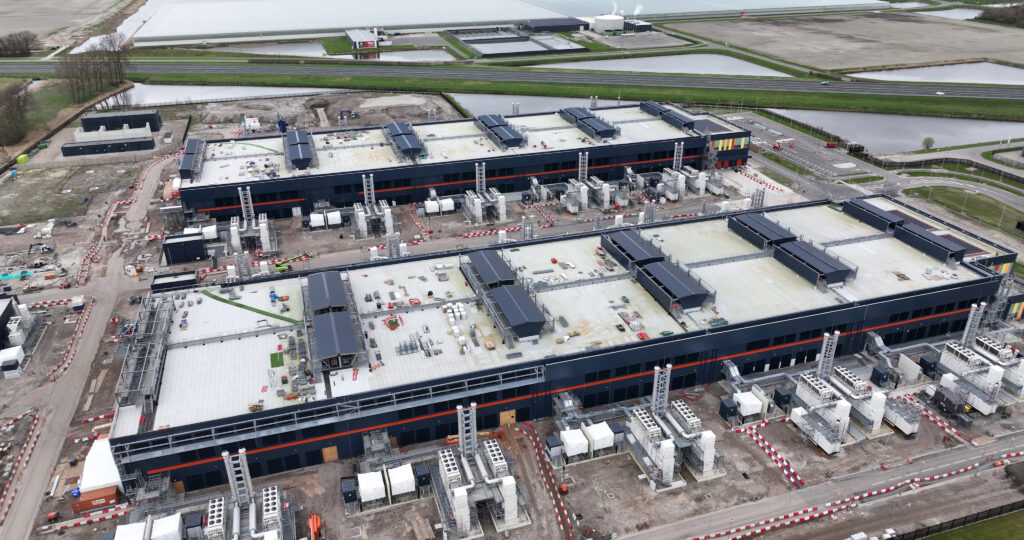
Corrosion-resistant • Non-conductive • Sustainable • Magnetically Neutral • ACI 440.11-22

Why Data Centers Need a Different Reinforcement Strategy

Data centers impose unique structural and operational demands: continuous operation, heavy and concentrated loads, and limited tolerance for intrusive repairs after commissioning. They are also electrically dense environments with grounding grids and high-amperage distribution near concrete elements.

Structural Reality

Electrical Reality

Environmental Reality

What Makes Basalt Rebar a Fit for Data Centers

Basalt reinforcement aligns with long service life requirements and electrically intensive environments, while improving constructability on large pours.

Non-Corrosive Materials

Reduces corrosion as a deterioration mechanism in slabs, foundations, and underground structures that become difficult to access after operations begin.

Electrical Non-Conductivity

Helps avoid unintended current paths and supports compatibility with grounding grids and power distribution near reinforced concrete elements.

High Strength-to-Weight Ratio

High tensile capacity at lower weight improves handling, placement, and overall constructability on large slabs and heavily reinforced elements.

Sustainable and Durable

Life cycle assessment studies on basalt reinforcement found that Basalt bars had the lowest environmental impact when compared with conventional reinforcing steel, stainless steel, galvanized steel, and GFRP bars
Where Basalt Rebar Is Used in Data Center Construction

Code-Based Design Engineers Can Trust

Design follows reinforced concrete limit-state principles with FRP-specific provisions for linear-elastic behavior, serviceability, spacing, and development length.
Design Standard

ACI 440.11-22

Analysis, design, and detailing guidance for FRP bars in concrete.

Representative Data Center Design Examples

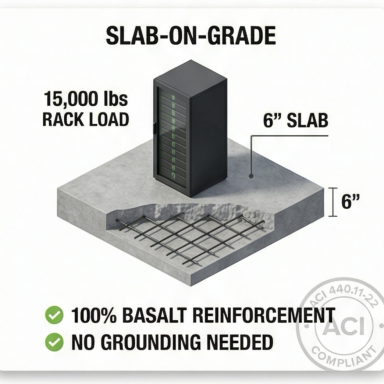
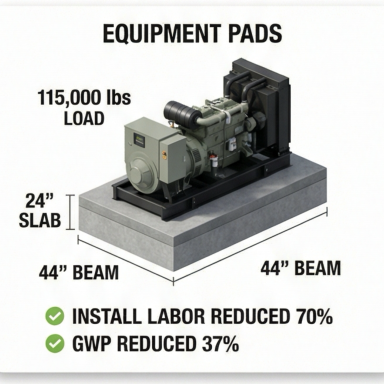
Illustrative examples show how BFRP reinforcement is detailed and checked for common data center elements.
sog_image
equipment_pad
Note: Examples are illustrative; final design remains the responsibility of the Engineer of Record.

Stakeholder Benefits Summary

Value by stakeholder—owners/operators, EPCs/GCs, and engineers.

Owners / Operators

EPCs / GCs

Engineers

Downloads

Technical Overview (PDF)

BFRP reinforcement for data centers: applications and illustrative examples.

Specification Starter

Division 03 starter language for BFRP reinforcement.

Request a Data Center BFRP Design Support

Tell us about your project. We’ll respond with the right documentation and next steps.

What We Can Provide

Need immediate help? Email or call us.

Email: info@basalt-usa.com
Phone: 
1-888-244-7865

FAQs

Is Basalt Rebar code-compliant for structural concrete design?

Design guidance is provided under ACI 440.11-22 for FRP bars in concrete.

Will Basalt Rebar corrode like steel?

Basalt Rebar is non-corrosive and avoids rust-driven deterioration mechanisms common to steel.

Does Basalt Rebar conduct electricity or interfere magnetically?

Basalt Rebar is electrically non-conductive and magnetically neutral, supporting compatibility near power and grounding systems.

Where is Basalt Rebar most valuable in a data center?

Slabs-on-grade, equipment pads, foundations, and underground electrical structures are common high-value uses.

Does Basalt Rebar change detailing requirements?

Design remains rooted in RC principles, but detailing follows FRP provisions for spacing, development length, and serviceability limits.

Protect mission-critical infrastructure with reinforcement designed for durability and electrical compatibility.

Schedule a short intro call and we’ll align on scope, documentation, and next steps.